
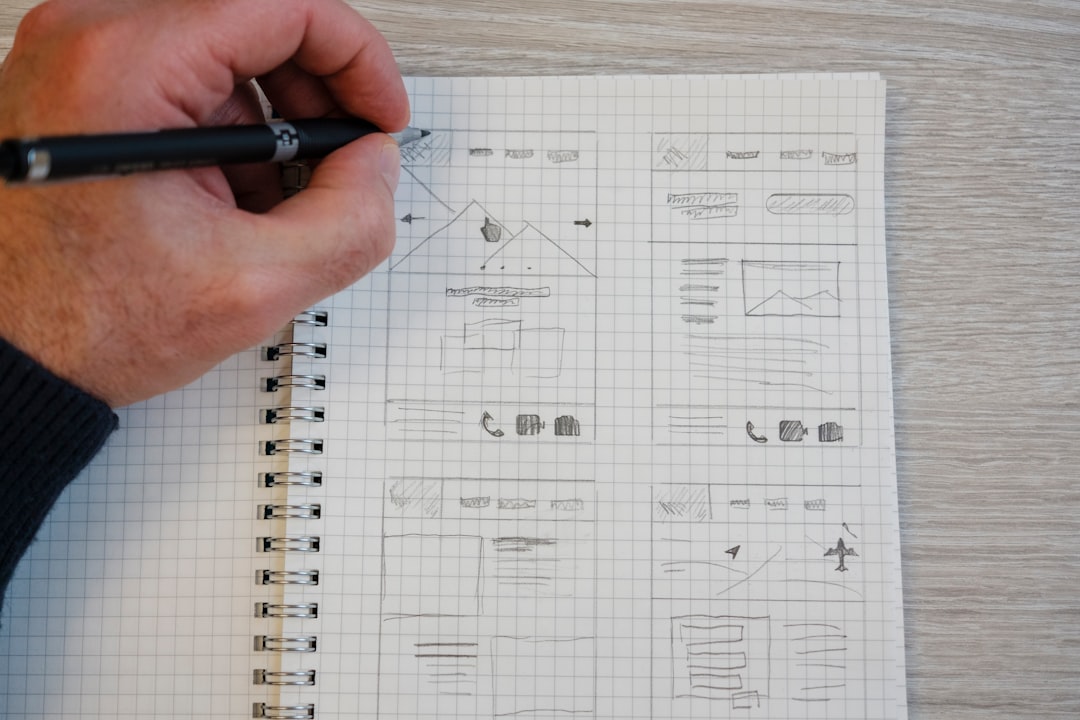

A visitor forms a visual impression of a website in roughly 50 milliseconds — fast enough that the brain has decided whether it trusts the page before it has read a single word. The first real decision, whether to stay or leave, happens in the next five to eight seconds. Most visitors who leave a small-business homepage do so within ten to twenty seconds. That means the first screen a visitor sees — the part above the fold, before any scrolling — is not a design choice. It is a business decision, and most small businesses are getting it wrong.
What “five seconds” actually means
Five seconds is not reading time. It is pattern-matching time. The visitor is not reading your headline word by word. They are scanning the page for signals: does this look professional? Is this the kind of business I expected? Can I tell what they do? Is there an obvious next step? Those questions are answered by shape, contrast, hierarchy, and the weight of the first few words — not by the full content of the page. The homepage that loses a visitor in five seconds is not usually the one with the wrong content. It is the one with the right content buried under visual noise.
Four things above the fold, in order
Every small-business homepage needs to deliver four pieces of information before the visitor scrolls. Not five, not three — four. They are:
- What you do, in words your customer would use. Not your tagline, not your mission statement, not your company name in a 72-point font. A plain-language sentence that tells the visitor what problem you solve. “We design custom WordPress websites for small businesses in New Mexico” is a homepage headline. “Empowering visionary brands to thrive” is not.
- Who this is for. One phrase, ideally in the subheadline or in a visible supporting line, that tells the visitor whether they are in the right place. “For founders, marketing leads, and growing agencies” is a qualifier. It saves both you and the wrong visitor from wasting time.
- One clear action. A single button or link that tells the visitor what to do next. “Get a Quote,” “Book a Call,” “See Our Work.” Not three buttons. Not a row of icons. One action, in a color that the eye cannot miss, placed where the scan naturally lands.
- One proof point. A single concrete signal that you are real and credible. A client logo row, a short testimonial with a name, a number like “20+ years serving New Mexico businesses.” This does not need to be large. It just needs to exist, because without it, the page is all claim and no evidence.
If those four elements are clearly visible without scrolling, on both desktop and a phone screen, the homepage is doing its job. Everything below the fold is supporting detail.
The three moves that waste the five seconds
Some patterns show up on small-business homepages so often they have become invisible to the people who built them. Each one actively costs visitors.
- The hero slider. An auto-rotating carousel of three to five images, each with different text, each competing for the same five seconds. Research on sliders has been consistent for years: most visitors see only the first slide, and the movement itself pulls attention away from the headline. One strong static image with one clear message outperforms a slider on every metric that matters.
- The vague headline. “Welcome to Our Website” and “Solutions for Your Business” are not headlines. They are placeholders that never got replaced. A headline should pass the five-second test on its own: if you read only the headline and nothing else, would you know what the business does? If the answer is no, the headline is not finished.
- Too many calls to action. Three buttons above the fold — “Learn More,” “Contact Us,” “View Our Services” — is not giving the visitor choices. It is giving them a decision problem, and the most common resolution to a decision problem is to leave. Pick the single action that matters most to the business and make it unmissable. The others can live below the fold.
What should be above the fold on a small business homepage?
A clear headline in plain language that says what the business does, a one-line qualifier that says who it serves, a single prominent call-to-action button, one proof element (a testimonial, a client logo row, or a credential), and a professional image or background that does not fight the text for attention. On mobile, where more than half of web traffic now arrives, this means every element above the fold must be legible at thumb distance and the call-to-action button must be reachable without scrolling. If your homepage requires pinching to read or hunting to click, half your visitors are already gone.
Performance is part of the first impression
None of this matters if the page takes four seconds to load. Research shows the probability of a visitor bouncing increases by 123 percent as page load time goes from one second to ten. Google’s Core Web Vitals set the bar at a Largest Contentful Paint under 2.5 seconds, and anything above that is flagged as “needs improvement” in both search rankings and user experience. An oversized hero image, an uncompressed video background, or a page builder loading three megabytes of CSS before the headline renders — any one of these turns a five-second window into a zero-second window. Speed is not a technical nicety. It is the first brand impression.
What a good small-business homepage actually looks like
The Massage of Santa Fe website is a good example of a homepage built around these principles: a clear statement of what the business offers, a clean visual that does not fight the text, one obvious path forward, and a page that loads fast on a phone. It is a small wellness business serving a local customer, which is exactly the context where these five seconds matter most — the visitor is often on a phone, mid-search, choosing between two or three options found on a map. The homepage that loads faster and communicates clearer wins the call.
If your homepage is not converting
Patrick Iverson has been building custom websites for businesses across New Mexico — Santa Fe, Albuquerque, Rio Rancho, Las Cruces — and the rest of the country since 2001. Most homepage problems we see are not about missing content. They are about the right content in the wrong order, or the right message at the wrong size. If your homepage is not producing the inquiries you expect, bring the URL. We can usually identify the five-second problem within a few minutes and tell you whether it is a quick fix or a rebuild.