
A bakery owner in Santa Fe hands a curious visitor a business card and watches the visitor pull out a phone and tap straight to her website. The visitor scrolls the homepage, sees beautiful pastries, and within ten seconds taps “About.” It is the single most reliable pattern in small-business web traffic. The visitor wants to know who they would be giving their money to before they decide if the pastries are worth the drive across town.
The About page is the most-clicked link on most small-business sites after the homepage, and it does more work than nearly any other page in turning casual visitors into customers. Yet on most sites I audit in Albuquerque, Santa Fe, and Rio Rancho, the About page is the weakest page on the site — vague, generic, and written as if no one would ever actually read it.
Why the About page matters more than it looks like it should
Industry research consistently puts About in the top two or three most-visited pages on a typical small-business website. Surveys of buyer behavior have found that roughly 52 percent of visitors say they want to see a company’s About page first when landing on a new site, and visitors who reach the About page have been shown to spend about 22.5 percent more than those who never look at it.
The reason is simple: a buying decision is also a trust decision. For services and considered purchases especially, the visitor is not just buying a haircut, a website, or a tax return. They are buying the judgment of the person on the other end. The About page is where they decide whether to trust that judgment.
What most About pages get wrong
Most weak About pages share the same four problems, and they usually appear together.
- It opens with a founding date. “Founded in 2014, Acme Co. has been a leading provider of…” tells the visitor nothing they care about. Visitors do not buy your age; they buy your judgment.
- It talks only about the company. The page is called About Us, so the writer assumes it should be about the company. But About pages convert when they answer the reader’s question — “Are you the right fit for me?” — not the company’s question.
- It uses meaningless adjectives. “Passionate,” “innovative,” “dedicated,” “client-focused.” Every competitor uses the same words. They prove nothing and differentiate nothing.
- It buries the person. Small businesses are almost always bought from a specific human. Hiding the person behind a wall of corporate plural (“our team has decades of combined experience…”) removes the single best reason to choose you.
What an About page should actually say
A useful framework: the About page has to answer five questions, in roughly this order. If it answers them clearly, length and prose style matter less than people think.
- What do you actually do, and for whom? One sentence. Not “we help businesses grow” — “I design brand identities and build custom WordPress sites for small businesses in New Mexico.” Concrete nouns. Specific audience.
- Why do you do it this way? The point of view, the conviction, the reason the work looks the way it does. This is where a designer’s belief that brand strategy should come before logos, or a contractor’s belief that estimates should be itemized, earns trust before the prospect ever asks for one.
- What is the proof? Years in business, specific clients, named outcomes, a credential or two. Not a list of every project — three real ones, named.
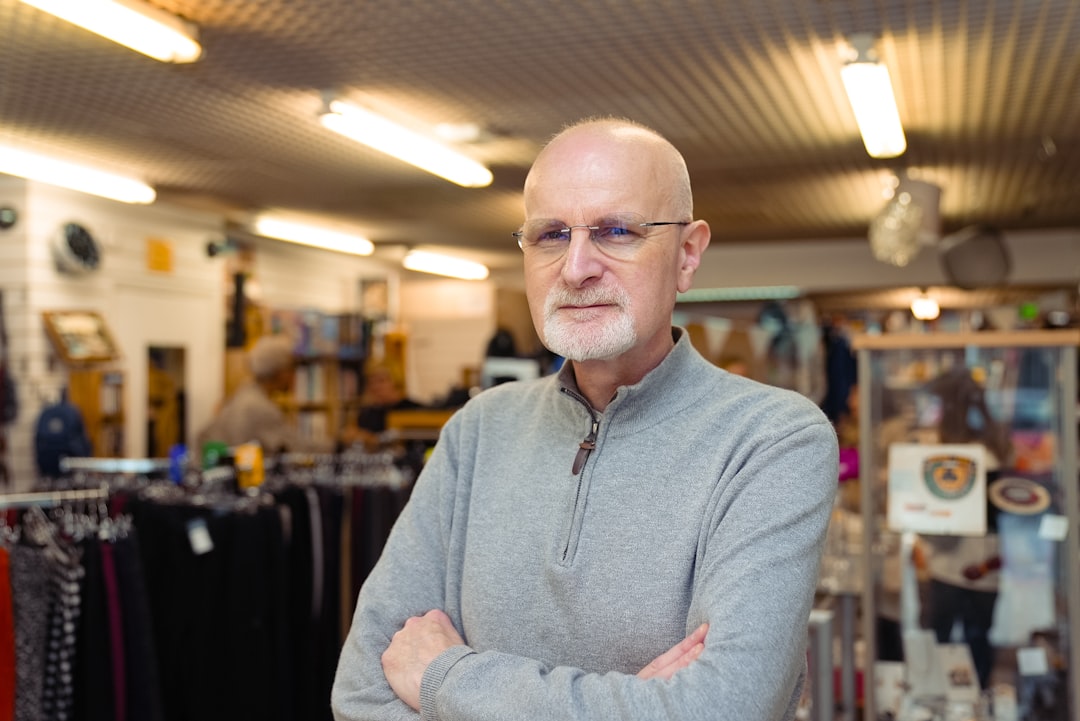
- Who, specifically, will they be working with? A name, a photo, a sentence of context. The owner’s face is one of the most powerful conversion elements on a small-business website.
- What should they do next? One clear invitation. Schedule a consultation, see the work, send a project brief. Not five.
Answer those five, and the page does its job. A good About page is rarely longer than 400 to 700 words. Length is not the goal. Specificity is.
Should the founder’s story be on the About page?
The founder’s story belongs on the About page when it actually shapes the work. A homestead farmer growing organic produce on three and a half acres in northern New Mexico has a founder story that is the brand — the scale, the soil, the family — and a visitor who knows it understands why the carrots cost what they cost. A national accounting firm probably does not need its founder’s hiking photos.
A useful test: would a reader who only saw your About page understand a real reason to choose you over a near-identical competitor? If the answer is yes, the founder’s story is doing work. If the answer is “she seems nice,” the page is leaning on personality where it should be leaning on point of view.
Words to cut from your About page
A reliable rewrite exercise: scroll through the current draft and delete every instance of these. The page almost always reads stronger without them.
- “Passionate about…” — replace with what the passion produces.
- “Leading provider of…” — replace with what you actually provide, to whom.
- “Cutting-edge” or “innovative” — replace with the specific approach that earns the claim.
- “Dedicated to client satisfaction” — replace with the policy or practice that proves it (a fixed-price guarantee, an itemized estimate, a one-week response window).
- “Our team of experts” — replace with the actual people, names, and roles.
- “Customized solutions” — replace with the actual range of things you build.
The pattern is consistent. Every cliched phrase is doing the job that one specific sentence could do better. Replace the cliche with the specific, and the page starts sounding like a person.
Photos, video, and proof
A few practical notes on the visual side, since About pages are also where stock photography does the most damage.
- Use real photos of real people in real places. A phone-quality portrait of the actual owner outperforms a stock photo of a “diverse team high-fiving” every time.
- Add a short video only if it is genuinely good. A 60-second founder-to-camera video can be the strongest conversion element on the page. A mediocre one is worse than none.
- Pull in named testimonials with photos and job titles. One quote from someone real, with a face and a company, beats five anonymous “Sarah K.” quotes.
- Show the work, not just talk about it. Three thumbnails of real projects linking to case studies do more than three paragraphs of self-description.
A practical rewrite plan
If your current About page is not pulling its weight, the rewrite is rarely as hard as the rebuild. Three sessions is usually enough.
- Hour one: answer the five questions, plainly. Type the five answers as bullet points, no formatting, no clever phrasing. Be specific. Be concrete. Cut every adjective you cannot prove.
- Hour two: turn the bullets into prose. Two or three short paragraphs. Lead with what you do and for whom. Put the proof and the human further down. End with a single invitation.
- Hour three: pictures and proof. One good photo of the actual owner. Two or three named testimonials with photos. Three project thumbnails or service links. A working contact button.
That is the entire job. Most small-business About pages are not bad because the writer lacks talent. They are bad because the writer was answering the wrong questions.
Patrick Iverson helps small and mid-sized businesses across New Mexico with brand strategy and identity, including the voice and copy work that turns a forgettable About page into one that actually wins clients. A recent example: the Reyah Sunshine Farm identity and site, where a 3.5-acre family homestead in northern New Mexico needed an About page that did the work of explaining why a small farm at the Santa Fe Farmers Market is worth showing up for. If your own About page is doing less than it should, the right first step is reading it out loud and asking whether a stranger would learn anything they could not have guessed.